Category Archives: machinedaudiohornlens.com

Machined tweeters and mid range horns for audio complete speakers. Klipsch drop in OEM replacements for tweeters

What will the future hold for YOUR companies data legacy?

No I have not died and shriveled up but I have been exceedingly busy with things and so the lack of posts for some time now. Getting rid of an accumulation of 10+ years of junk in my shop and getting ready for a new Haas Mill and Lathe. Add to this a rather thankless round of CAM program shopping that seems to bear far to close a resemblance to shopping  for used cars in all the wrong places. Before you know it two months can fly right by. But any way, on to the real story.

One of the chief reasons I first decided to look at SE was because of the ability to work on any geometry without fear of how was it created or who created it. the following three years have proven to me that ST is the the correct choice for this and I intend to have a few further examples why in the near future. But in the mean time there is an interesting webinar coming up that will reflect in part directly upon this very topic.

I got a call from Billy Oliver some time back when he was still using SW. For all of the reasons we see so frequently in blogs and posts and user comments he was very unhappy with what was going on and was looking for the exit. He goes back in the CAD world much farther than I do and has a wide variety of experience and I find him to be quite interesting to talk to. We talked about why I liked SE, in particular of course the Synchronous side. Shortly after a trial run for SE the company he works for switched from SW to SE.

My experience with SW is quite limited as the two times I went to see a demo it just never clicked with me. The first time I saw SE before the release of ST1 it just made more  sense in the logic of it’s workflow to me plus of course Synchronous and SW never had another chance. So the comments of those who really have been on both sides of the fence are of great interest to me. If you are one of the many with question marks about the wisdom of staying with a company like DS/SW that seems determined to do bad things to you like the cloud, gamification of cad, [can I ask what moron thought that up as a desirable idea!! ] and the insanity of a kernal change inflicted on a pretty mature product. You all know this is not conjecture as the leadership of DS and SW both are telling you this is the way it will be. When Jeff Death Ray spoke it was not an idle jest and the power supply is being hooked up to the Ray Gun right now.

Billy will be part of an upcoming webinar with the title   ” Hear why Helena Labs ensured the future of its core CAD data”  and the article is in it’s entirety below.  I should think it would be of interest to many of you.  I will be there and hope you will to.

the LinkedIn app for iPhone and Android.
//

                        Free Webinar: Hear why Helena Labs ensured the future of its core CAD data- Nov 8,2011  2 PM EST

Solid Edge Webinar

Event Date: 11/08/2011
02:00 PM Eastern Standard Time

At the core of your mechanical CAD software is the modeling kernel, an often overlooked tool. The kernel is key to your ability to compute 3D shapes and models and output 2D drawings from 3D geometry. In this webcast, learn the basics about kernels and what impacts a change in this core code can have on your company’s existing and future design data. Dan Staples, development director for Solid Edge at Siemens PLM Software, is joined by medical device designer Billy Oliver from Helena Laboratories to explore the issues facing hundreds of thousands designers and millions of CAD files.
• The math inside your feature tree
• Real-world lessons learned in changing kernels
• Modeling loss, data protection, and reuse risks
• Impact on hundreds of thousands designers and millions of CAD files
• Case study: Helena Laboratories ensures data protection

Register Today
http://am.siemensplmevents.com/?elqPURLPage=7723

And so what CAM program do YOU use?

  I almost, well kind of, hesitate before I open this can of worms. I find myself getting ready to cut the last strings to VX/ZW3d which are the ones from cam which I still use. So off I go into the quagmire of what to choose.

  Getting input from sales people, forums, user reviews and the rest always leaves me scratching my head over why is it so hard to get real information to make the best decision by. I have a shop close by for instance where the owner had a seat of OneCNC. He was at the time pleased with it. When I went to watch it cut my comment to him was “why does it cut so much air?’ I could see it go over the same spot time and again not cutting anything. So we go forward a couple of years and he tells me that he is replacing it with HSMWorks. After four months of use he still likes it and I will be having a look tomorrow in actual use in his shop.

   I understand that equipment and what you need your equipment to do can change over time necessitating a change in software. What I don’t so readily understand is how cam software is still at this time such an expensive thing and still chock full of problems that never seem to be resolved by actual testing before it is released to be used on real equipment owned by paying customers. 

   EVERY single cam program out there has problems and once again it seems the buyer is reduced to hopefully discovering the gotchas before the 30 days are up on the trial. He is for sure going to find most of them after the trial is up because there is just not enough time to really assess a program and still go about your daily earning a living routine. It is tantamount to picking the problems you can best  live with and forget the idea that you are going to find a program that just works with all the tool types and strategies you need.

   One of the sad legacy things that SE has to deal with is the lack of third-party integrated programs. In all these years the closest thing UGS etal has come up with is Cam Express which is not directly integrated and costs a ton of money. I know they are working on all this and within a year I am quite certain there will be cam for and integrated with SE just like I want it. But in the mean time I have to make a living and with new equipment coming in this year I can’t wait.

  So for all of you who actually design and them manufacture your own parts I ask for some feedback on what you use and like keeping in mind the following. I don’t need to be able to tweak the last millisecond out of the cut time for a small parts run. I need to get a cut plan QUICKLY and one that will cut efficiently but not a day in and day out perfect production cam plan. I would like integration with SE if possible and if not a good set of translators. Milling up to true fourth axis and lathe with a possible “c”axis. High speed machining and arc fitting. The equipment will be Haas so the post processors need to very good for them. NC code editor. You get the idea, I want something that works quickly in a production shop floor environment that gets me fast cam plan creation and good cut paths without a bunch of click-click page-page 8 million parameters to be filled out first to get there. Yes I know a certain amount of this is necessary for the creation of good cut paths but it seems as though you can go from cookie cutter to the labyrinth and I want a happy medium.

  At this time I don’t care so much for integration as much as I care to find effective and not the price of a new truck and then the gas for the gas hog each and every year there after. Please I am not looking to start a cam war here but I am looking to get real feedback from actual users. If I find any from cam resellers be warned, sales pitches are going to go bye-bye.

   I am also looking for information on where I can go to get unbiased information. Yes I know about all the forums and I question the ability to get good information from many of them. I would like to hear from you irregardless of what cad program you are using.

ST4 IS ON THEWAY !!

    Recieved a letter today from one of the Siemens SE people telling me that ST4 has been released.  I look forward to delving into this new release. From the things I am hearing back from beta testers this one is mostly about making it work well for users and short on useless window dressing which is meant to work well for share holders. I am pleased to see this direction with SE and all I can say here is that it is nice as a customer to be involved with a company that is as concerned about my ability for geometry creation as I am.

The Slow Motion Trainwreck of a CAD Colossus


CIMdata comments on major events and trends in the Product Lifecycle Management (PLM) market.

Dassault Systèmes Takes to the Cloud (Commentary)

PDF | July 14, 2011 

http://www.cimdata.com/publications/pdf/Commentary_DS_Analyst_Event_14July2011.pdf 

  In part I quote, 

  “The application which gave this meeting its name last year, 3DSwYm (See what You mean), had a more prominent role this year. Beyond its use to power the DraftSight community, 3DSwYm was central to many of the “experiences” shown in the industry tracks. Dassault Systèmes sees this social computing platform as a force multiplier, letting the crowd leverage the cloud, so to speak. With the general availability of the 3DSwYm platform, the market will decide. Mr. Florack also stated that “mobile is inevitable,” and showed an early version of an iPad V6 application, with content channels that users can “follow.”   ( Ha Ha, here’s your IPhone type stuff again Roopinder:-) 

  Other Analyst sessions included updates from all of the Dassault Systèmes Brand CEOs, and several industry leaders. The message was consistent from all: experience is central to the company’s strategy. All Brand promises revolved around the notion of experience. Lynne Wilson, CEO of the 3DVIA brand made a telling remark, one that has been prominent in the trade press recently, and is core to the Dassault Systèmes strategy—people who grew up with games and the Web have different expectations. Meeting these expectations with powerful, yet easy to use business applications is a huge challenge to all PLM competitors, not just Dassault Systèmes. At least outwardly, the industry messages shifted from 2010, from a plethora of industry-specific business processes to experiences, like the “Global Science Solution Experience” in Life Sciences, drawing on the biointelligence project that Dassault Systèmes helped initiate in 2009. Those processes still exist, but they are no longer the lead in the presentations, which is consistent with the overall “deliver experiences competitors can’t match” theme. According to Dassault Systèmes, those processes are old school, and Dassault Systèmes is certainly trying to change paradigms, which is the “Dassault Systèmes Way,” another messages consistently used in the industry slides.” 

   Don’t you just love mindless corporate PR babble? A really scary thought here is that they probably think we believe they sound erudite and will get excited over what they say.


    Dassault is bringing a philosophy of “socially immersive experience” to their software. This is great for goof offs but is a failed recipe for corporate productivity. And as an aside here this does not even get into the cloud aspects where infrastructure problems and security risks have not been solved. Can any of you reading this prove they have been? Go on, I dare you to try. Every smiley face PR release from self interested vendors you can find I can find actual reports of failures far exceeding yours in number from people reporting on real life results. Or into the aspects of kernal change at the core of the cad tools. 

    Gen Whatever, todays colledge grads and professionals according to HR gurus must be allowed sufficient time each day for social interaction, or “experience” as Dassault would say, unrelated to the job. Must be kind of like the chain smokers routine used to be where they would take off and burn one leaving those who did not to take up the slack. Now we have the socially enlightened ones who do the same leaving the productive socially inept backward looking no tweeting neanderthals who don’t to pick up the slack. Reality is if you tweet a bunch during work hours that is time not spent at what you are employed to do. Reality is if your software is dictating tweet type tools be used by you, you are not spending time at what you are employed to do. 

  So now we have the promotion of this “Experience” mindset by Dassault/SW whose reason ostensibly for existance is to promote and enable effective manufacturing principles and paradigms. Here the reality is that if your new software tools do not contribute to to productivity and efficiency they must be doing the opposite. Kind of like writting Tweet software for engineers when what they want is effective geometry creation. 

  I think the words picked to talk in public about software offerings are a window into the soul of a companies leadership.  The “Velocity” mess was the outward manifestation of a company that had no clue about users or marketing  in the recent past with UGS. Today we see an even worse set of concepts by Dassault and it is a window into the missdirection coming straight from the top. This is not going to be reversed until some time in the future after a lot of businesses and customers are lost and existing incompetent management is fired and replaced.

    Contrast this with the current direction at Siemens SE where the corporate directives are dedicated to “Design Better” and they mean it and are implementing it with this odd concept of better geometry creation tools on users desktops where work is actually done. Assuming of course copious tweeting is not going on. But the beauty of an autonomous cad seat freed from the vagaries of web and cloud and “immersive” stupidity is that a company can quite easily keep social junk away and keep the reason for employment with better more productive tools a reality. You did as a company hire individuals to generate profit didn’t you? 

   It is to me a fascinating thing to watch developments in our CAD and CAM industies for better or for worse. I stand and watch Dassault/SW and read what all the actual users of their products are saying and the response of actual users to new offerings. I just can’t grasp with how such a huge and fundamental dis-connect from reality can emanate unchallenged from the top of Dassault.

MBA CPA made in China junk could be an opportunity for you

  
  China and quality problems. Why if your CPA or MBA boss or supplier thinks heaven is in China you better start looking for the exit or think of building your own factory. 

  I don’t know how many CAD readers of various blogs are actually involved in the manufacturing of what they design. Comments I hear on occasion lead me to believe that most just design and manufacturing is that stuff that happens somewhere else. This post is primarily for those who do manufacture. But then again if you are one of those who buys from places like Walmarts and get on the tread mill of returning defective “MICS”, otherwise know as Made In China Poop this will be of interest to you to.

  Manufacturing is going to have to return to the USA if we are to remain world leaders and maintain a good standard of living. It is not an option. I hear more and more of cases where even these MBA/CPA idiots are begining to realise that the true cost of MICS far exceeds the contractural costs and they are left holding the bag. Thankfully Engineering degrees are on the rise and MBA/CPA’s are on the decline as Darwins Law eliminates the parasites that kill their hosts off.  Funny how it is that if all the new jobs are burger flippers that no one has money to buy  the MBA/CPA MICS  anyway so even they eventualy get canned when their short sighted make money today and the heck with tomorrow stuff catches up to them.

  There is an increasing demand for quality, on time and as specified products that won’t have two months of bad in the pipeline and you promise and deliver just such a thing you may be surprised at the amount of work out there. All of the modern cnc shops with good QA that I know of here in Middle Tennessee are busy and a lot of it is just for these reasons.

  The following is a letter I have sent to some I know.
 
 
  I bought a Vectrax # 923003 bandsaw from MSC about three months ago. Worthless piece of junk, lists for $1,689.00 in their catalogue by the way, gave nothing but trouble and then just quit. MSC was clearly aware of the problem and in discussing it with a warranty guy this is what he had to say. About three years ago the Chinese quality had reached it’s zenith. Then things started going downhill and in spite of complaints nothing was done. Finally MSC was told to just accept whatever they were sent or go some where else. The Chinese were selling enough poorly made bandsaws to the domestic and Indian markets that they felt no need to provide quality and they were not going to do so. MSC does not know what to do about this at this time. My reply to this statement was basically that you knowingly sold me a piece of junk and it has cost you my business in equipment.

   The second was a shop in Nashville that sells a lot of Jet equipment new and scratch and dent. So I am standing next to the counter the other week while shopping for a replacement bandsaw when I hear a sales guy talking to a customer about parts for his lathe. One part would be in in July, another in August and the third in NOVEMBER. Could your business survive the loss of the use of a piece of equipment for five months? Parts from China only when the shipping container is full. (And what do you do if it is full of bad parts?)

   Finally, I have a Jet 14-40ZX lathe that cost me $12,500.00 over 10 years ago. Lots of bad things on it and all the fasteners basically look good and are inferior quality steel. But the kicker for me was the splined shaft the speed range gear clusters ride on. It will twist under load and become siezed in place. I use design software and I know how easy it is to match an output shaft to the torque level put out by your motor. But the right steel precisely cut costs more so the Chinese won’t use it. This is on an ISO 2001 cert lathe by the way as proof these certifications are useless when in China.  I recently replaced for the second time this splined shaft and it was dramatically worse than the first replacement one was. Both ends had to be polished down to fit into the bearings. It was about a two hour job with layout blue and abrasives to get the shaft to fit with the gear clusters. There are four  keeper rings on this shaft. the two mid shaft ones were cut approximatly 3/16″ off which meant that the shaft end cover on the chuck side of the headstock now has a 3/16″ gap between it and the side of the lathe. I can make it work but you know what? ISO 2001 means that all parts are to fit correctly. Chinese reality in my experience is none do. I will be replacing this soon with a Haas Toolroom lathe. I know parts are available quickly and oddly enough they even fit and work right. Yes it is three times the price but I am getting ten times the machine and it’s cnc to boot.

   In light of these things the following letter was of particular interest to me.

 
  Paul Midler is the author of this by the way.

      
   “Recent media reports detailing a series of quality problems with Chinese-made exports–pet food tainted with prohibited chemicals, toys covered with lead paint and tires that fall apart at high speed–have understandably alarmed the American public and resulted in a number of international product recalls.

But supply chain professionals not directly affected by these recalls remain unusually calm. “Everything will be all right,” said one U.S. importer on a buying mission to China. “As the country continues to develop, the quality of its products will naturally rise.”

It’s the sort of comment that sounds logical, but is not necessarily true. Quality does not always rise over time, as China’s own history shows. At the end of the 19th century, the West rushed to buy China’s beautiful silk products. Demand quickly expanded, and new players moved into the market. As competition intensified, manufacturers began to cut corners on quality, and silk products out of China soon gained a reputation as inferior goods.

By the beginning of the 20th century, traders were already looking elsewhere, and Japan, which had been building a reputation for delivering a more consistently high-quality product, became an attractive alternative. By 1930, Japan was exporting twice as much silk as China.

One of the problems facing China is that manufacturers continue to engage in a practice I call “quality fade.” This is the deliberate and secret habit of widening profit margins through a reduction in the quality of materials. Importers usually never notice what’s happening; downward changes are subtle but progressive. The initial production sample is fine, but with each successive production run, a bit more of the necessary inputs are missing.

What is maddening to importers is that quality fade often occurs in the last place an importer thinks to check. One American company had been importing a line of health and beauty care products for over a year when the cardboard boxes that held its product suddenly started collapsing under their own weight. There was no logical explanation for the collapse except quality fade, and the supplier in this case blamed subsuppliers for replacing an acceptable cardboard box with ones that were inferior.

The Case Of The Missing Aluminum

Some quality issues are not all that serious, but others are downright frightening. One of the most disturbing examples I have encountered while working in China involved the manufacture and importation of aluminum systems used to construct high-rise commercial buildings. These are the systems that support tons of concrete as it is being poured, and their general stability is critical.

The American company that designed and patented the system engineered all key components. It knew exactly how much each part was supposed to weigh, and yet the level of engineering sophistication did not stop the supplier from making a unilateral decision to reduce the specifications. When the “production error” was caught, one aluminum part was found to be weighing less than 90% of its intended weight.

Where did the missing aluminum go? Into the factory owner’s pocket as a cost saving. The only thing passed on to the customer was an increase in product risk. Quality fade is like the straw that broke the camel’s back–only in reverse. Suppliers push the limit by taking more and more out of the equation until they are caught, or until disaster strikes.

Even when importers catch suppliers in a quality fade, they frequently don’t do much about it. Many quality problems are seen as too minor relative to the difficulties involved in rectifying them. Customers may not notice a product flaw, but they most certainly notice when a product is not delivered on time. The chance of a product failure is usually remote, but the penalty for late delivery is an almost certain loss of business.

Some importers bravely attempt to fight back against quality fade by insisting a supplier replace substandard goods at the factory’s expense. A savvy supplier–and most are extremely savvy–can respond to such demands by threatening to terminate the supplier relationship. Or the supplier can respond by raising prices. Importers might then say they will switch suppliers, but the factory owner knows this is an empty threat as finding and cultivating a new supplier can take a long time. And anyway, there is no guarantee that the next supplier won’t engage in the same willful behavior as the first.

The factory owner who practices quality fade knows exactly where he stands with his customer in these cat-and-mouse games. He has virtually nothing to lose and only margin to gain–and, having gotten away with it once, no one should be surprised when he goes for it again. When the factory owner offers his most sincere apologies and promises that it won’t happen a second time, importers simply close their eyes and hope for the best.

If Adam Smith were around today, he would have had to write a separate chapter on global outsourcing. Because it takes importers a long time to find suppliers and to get them up to speed, importers keep their suppliers a secret. The last thing that an importer wants to do is let his competitors know the source of any supply chain advantage he may have. Even when it is in their collective interest to share information, importers keep to themselves.

As a result, factories pay little, if any, reputational cost for production shenanigans. The invisible hand doesn’t work well when the manufacturers themselves are unseen.

This lack of accountability also has legal implications. When a product is recalled in the U.S., the importer pays the cost of that recall. It remains next to impossible to take legal action in China, and only in the rarest case can an importer successfully sue the supplier responsible for a product failure.

Since most suppliers are paid in full well before goods leave the factory, the importer doesn’t even enjoy the leverage that comes with owing payment to the supplier. The average importer has far less leverage than imagined.

Outwitting Third-Party Testers

In the wake of quality problems, many are looking to third-party testing as a solution. In theory, testing works well. Prior to exporting a product, the supplier takes a sample and sends it off to a reputable and international testing laboratory, which then checks to make sure the product is safe. Unfortunately, testing doesn’t work well when a supplier sets out to circumvent the system.

I recently worked with one supplier that was encountering difficulties making a quality liquid soap for export to the U.S. To get around problems the supplier was having with laboratory results, the supplier created 10 random samples and sent them to the same lab for testing.

Nine of these samples failed, but one passed. The supplier took the one test result marked “passed” and sent it off to the customer. The U.S. company never knew about the failed results, and a purchase order was promptly issued.

Third-party testing is far from fail-safe. Consider one study conducted by the U.S. Consumer Product Safety Commission in 2001. In a review of nearly 200 recalled electrical products from China, the CPSC found that more than 25% had had prior approval by an international third-party testing agency such as Underwriters Laboratories (UL), Intertek Testing Services (ETL) or the Canadian Standards Association (CSA).

Both The Wall Street Journal and the New York Times have suggested that the solution to China’s quality problems lies in greater vigilance on the part of importers, but the question remains: If professional third-party testing agencies are failing to catch product failures, how is the average importer expected to do so? After all, third-party testing agencies have far better resources, and their people are much better trained.

Private quality assurance programs may also be put in place, but suppliers can circumvent such controls as well. In one case, after a load of plywood was rejected at one factory, the supplier simply mixed a portion of it with product that was perfectly good in later shipments. Working the bad into the good is a common way for a factory to reduce loss.

A supplier can bury substandard product knowing full well that warehouse workers in the U.S. do not have the time to examine each piece that comes in. And detailed contracts cannot succeed in bridging any moral gap. In order for supplier relationships to work successfully, there must be a basic level of trust.

Get Rich Quick

In an effort to reduce risk, American companies are also looking to suppliers that are larger and seem more capable. The unfortunate fact about China’s larger factories, however, is they charge more for product than smaller factories do. It is as if economies of scale do not apply in China. There are several reasons why China suffers from such a problem, and one has to do with the role government plays in manufacturing.

Where a small factory may have been funded entirely by the government, future expansions are more often privately financed. Making the matter worse are extremely short payback periods on private investment. Many factories hope to pay off investments in as few as three years. One of the worst things an importer can hear is, “We want to show you our most recent expansion.” The more a supplier invests, the quicker it raises prices.

There is a sense of urgency in China, the feeling that one must work fast before the window of opportunity closes. For factories, that means taking shortcuts on quality. Many factory owners can’t see beyond the next purchase order.

One reason for the short-sightedness may have to do with China’s political environment. The one-party government does what it wants, when it wants. And while there may be some advantages to a government that can operate without restraint or controversy, such a system limits predictability and leaves the business sector keenly aware that it is subject to the evanescent whims of officials who may or may not know which policy is best.

The U.S. administration has recently been applying pressure on China to revalue its currency in order to close the growing trade gap between the two countries. To appease the U.S., China has responded by reducing the tax rebates it offers to manufacturers.

For some suppliers, the tax rebates have constituted a major portion of their bottom line. Massive and sudden changes such as these only confirm the factory owner’s paranoid suspicions that the manufacturing opportunity could disappear at any moment. No one in China is sure how long anything will last–a situation that keeps many focused on the immediate present.

Chinese manufacturers that engage in quality fade unfortunately subscribe to the view that business is about increasing one’s share of the pie rather than growing the pie over time. They often focus on extracting profit through short-term maneuvers that inevitably militate against long-term development. This approach, it should be noted, contrasts sharply with the success strategies of such economies as Japan and Korea, which focus on building market share and developing strategic relationships.

Playing It Short

Some blame quality problems and product recalls on the relentless pursuit of lower prices. Importers most often go to the cheapest supplier, so the supplier who quotes low and quietly cuts corners on quality is the one who wins. Honest suppliers who prefer to quote higher and offer a better quality product lose out. The supplier who obfuscates catches orders first–and most often.

Chinese suppliers are excellent at playing the short game. When an importer discovers a quality problem late, the factory turns around and suggests, “But you signed off on the original production sample yourselves.” When goods arrive damaged in the U.S., the factory claims that the importer has been making up the story in order to lower import costs. Arguments like these work in the short term. Over the longer term, however, importers get wise, and alternative markets start to look increasingly attractive.

China’s quality situation is by no means hopeless. Japan was known decades ago for making inferior products, but that changed. The key to turning the situation around is to incorporate a habit of quality into the culture. China, however, has not shown that it has any interest in doing so.

Recent accusations of unreliability in Chinese products are now being met with tit-for-tat claims that U.S. products are faulty. This is an unfortunate strategy for China, and it means that we will continue to see quality problems. China will not be able to succeed so long as manufacturers are competing in a race to the bottom.”

Paul Midler is the founder and president of China Advantage, a services firm that provides outsourcing and supply chain management to U.S. and European companies. He has been involved with China for more than 15 years, and in the course of his manufacturing career, has had dealings with thousands of Chinese factories.

                                          Have a good 4th, Dave Ault
Solid Edge user groups

   One of the building blocks of any cad user community is the establishment of user groups. Local user groups are where individuals can turn for help from warm bodies within easy driving for what ever reason. Professional and social ties are established with individuals  who have common ties to the benefit of all concerned.

  Now I know this is just common sense to many of you reading this because if you are here you are allready more interested in software than the typical user. You are familiar with the concept and have at least thought about it even if there was no desire to attend or resource to be found.

  I have admired the size and activity of the SW community and in fact this is one of the things that almost got me there. It is one of the things that helped SW get to where it is today. It is one of the things that has been lacking in a big way with SE.

   Today I am pleased to say, with proof, that this is changing. This is one of the problems the new deal at SE is not only aware of but going to fix.  In emails today in part I recieve the following.

  “Dear Edgers,

     Thank you for agreeing to support or continue to support regional Solid Edge user groups in your areas.  As discussed, we are putting in place infrastructure to help with this effort.  We are also in the process of opening a full-time user community support position. 

We would like to start the process with you on Friday with a kickoff call.  Hopefully this time works for you all.  If you have a conflict, please let me know and we will try our best to find a time that is convenient for all.”
 
   Money and time is being put where the mouth is and this is one of the things promised to us. The Huntsville Summit really was the launch of a new philosophy towards users and so far every, and I mean that, every promise made to us has been kept.  There are others to be announced shortly and this change is for real.
 
  To all you SE users reading this. It is time for you to think about your user community and the software you use and how Siemens/SE is going to work with you. Note that I said going to and there is no ambivalence there is there. It is time for you to think about the idea of working with them.  I would even suggest that it is time to get involved.   


Solid Mastermind, a good way for a cheap look under the hood.

  For all of us attending the Huntsville ST4 rollout there was a bonus. One month of Platinum level access to the Solid Mastermind web site tutorials and material for SE.   http://www.solidmastermind.com/

    I have been fiddling with it for the last few days and shocking as this thought may be have a few things to say about it. The video clips here just appeal to me more than printed manuals would as watching something being done is a faster way for me to learn than reading stuff put out by companies that are out of date before you get them.

  Technical material for the software you buy has always been one of my pet peeves in that you either muddle through on your own with the scarce and incomplete corporate literature that is available, get “official” training from VARS or Corporate or find another user who will help you . I did this years ago with VX and it cost about $1,500.00 for each person for two courses of training. This is a pretty typical cost I am finding out and NO you can’t record what you are looking at so you see what you see in the classroom once, and then leave with so much stuffed in there that most of it is useless.  They did however give us a stack of books printed before the release of the version we were in training for and as you can imagine it was allready incomplete and each service pack made it more so.  Does this sound familiar to you?

    So I go to the Mastermind site and check it out. I went through five of the ST3 part modeling series and was a little surprised at how much I did not know. I am in the same boat as many as we sit down and figure out enough to get us through the job or project at a reasonable level of efficiency and stop there. It was a bit startling to see all the bits and pieces I had missed on my own in these videos.

   So I come to some conclusions about all this. It really does seem for whatever reason that third parties produce better training material. Mastermind fits into this category and beats the pants off anything I have seen from Siemens or SE and I am glad to see Mastermind and Siemens get together as this does fill a sorely lacking need.  For ST4 I am going to be there as a cheap way to get up to speed on what is going on.

   The thought occured to me though that this site also serves well those of you who wonder just what is under the hood with SE. I know all the costs in moving from one program to another. I know all or most of the excuses used to stay or go from your current program as I have either read them or said them. I can say without reservation that if you want to know about SE and it’s capabilities you will be well served in getting a couple of months here. As far as I can see it is by the month by the way with the most expensive level being $97.00 per month.

      Lets talk user to user right now. There is no greater dis-service another user can do to a potential user than gloss over the problems or capabilities of the software he uses because he is a mindless fanboy and just wants you and himself to believe he made the best choice. You have a lot riding on what you use for a living  and if you are like me you want truth. Let me know the shortcomings and and pluses I can decide what I need from there. Every software has it’s trash side and it’s good side and you just need what best fits your situation.

   I will recommend, if you are interested at all in SE, that you go here for a couple of months and see exactly what it does and does not do. Kick the tires without kicking your wallet and time in the butt first by seeing exactly what the capabilities are without having to first buy the software to find out.

  I like what I see, with both SE and Solid Mastermind, and I think you will to.

Some thoughts on ST4 and Huntsville

  It’s Saturday morning and as I get ready to head out to a customers factory today for work I am reflecting upon what has happened with SE since I came on board three years ago. Here are some of the thoughts.

 A week is gone allready since Huntsville and I have been quite busy. This is not an SE post as much as it is a kind of lazy way for me to be able to say to everyone I met that it was a real pleasure to be there and meet you.

  This forum  ( the bulk of this was posted today on the SE BBS so thus the forum reference) and the way VELOCITY, with the backbone of the whole thing SE in tiny letters if at all, was being handled was a pretty discouraging thing when I first came here even though I liked the software. It certainly is not that way anymore .

  I believe that this Huntsville meeting (New Summit 1 ;-}) will in time be regarded as the time that marks the spot for SE having turned around in all areas.  I watched cynical and disparaging  long time users who really know their stuff get excited and leave excited.

  I remember chairing all the SE sessions at PLM World three years ago where just 37 SE users attended and it was an unhappy group. PLM World was a stuffy suit and tie kind of thing and SE users were as far as I can see a rolled up shirt sleeves hands on bunch stuck over in the broom closet. By the time it was over I was pretty disgusted with the whole situation. What a difference a few years make.

  Users can whine and carp about things and some of us can even make a big stink about it where ever they can find a chance to do so. And the web gives many chances now a days. But until there is a change of heart or a change of guards at the corporate level nothing good will happen. This user wants to express his sincere appreciation to those in corporate, you know who you are, that had the vision to see where SE could be and should be and determined to fight those with stultifying vision or direction. It was a thrill to be in Huntsville and see proof of concept in both software and dedicated new corporate support and direction.

  For those of you who missed this year, sorry but there will never be another one like this one was where you could have been at the new begining. But next year there will be another one with many more in attendance and you CAN be at that one.

Why VX ZW3D failed for me

   I don’t intend to ever post many things like this but I got a letter from VX/ZW today talking about a PCR turned in and rated high priority in 2005  [ yes 2005, I did not screw up on the digit] and still not fixed. But they give me an update to let me know it has been moved from VX to ZW. If I knew how I would put one of those really angry red faces here. Or put in purple letters how I love VX.  Sheet metal was the straw that broke the camels back for me where VX was concerned.  There were lots of other issues but I could work around them even though I resented having to do so.

   When I talk about having sympathy for anyone who is unhappy with their CAD or CAM program I am not kidding. I have been down that path and I have really resented putting time and money into a cad program that had problems like VX did. When I talk about the pain of staying was worse than the pain of leaving this attached copy of the letter I got today is a fine demonstration of why it was time to go.

   SIX YEARS AND THEY STILL CAN’T CLOSE A CORNER IN SHEET METAL THAT IS NOT A 90 DEGREE ANGLE!!!!   

    End of rant and imagine purple all over the preceeding paragraph. 


—– Original Message —–

Sent: Wednesday, June 22, 2011 2:25 PM
Subject: VXQA Report 17553
 
> Version – 11.31
> Platform – Windows
> OS Version – XP
> Severity – E – Enhancement / Suggestion
> Priority – A – High Priority
> Module – Sheet Metal
> Submodule – corners
> Status – OK – Not a problem
> Keywords – mjl 11.0 sheetmetal
> Assigned – VX
> Estimated Resolution – ZW
> Short Description: Need to make the Close Corner command more robust
> Diary:

> ===== Diary Created By   VX  on Tue Sep 6 10:40:50 2005 =====
>
> When adjacent flanges of a sheet metal part are not both at 90 degrees, the close corner command fails. 
> See the attached part.  We could eliminate 10 commands from the history if the close corner command would

work here.
 
> ===== Diary Updated By   VX  on Tue Sep 6 12:35:22 2005 =====
>    Estimated Resolution changed from NYS – Not Yet Scheduled to Future Release
 
>    Assigned to VX Development
 
> ===== Diary Updated By   VX  on Wed Jun 11 11:50:24 2008 =====
 
> ===== Diary Updated By   VX  on Wed Aug 4 13:38:13 2010 =====
 
>    Assigned to VX Development
 
>    Email Tracking List changed from
 
> ===== Diary Updated By   VX  on Fri Aug 13 14:55:50 2010 =====
 
> ===== Diary Updated By   VX  on Tue Jun 7 03:31:19 2011 =====
>    Status changed from Open to OK – Not a problem
 
>    Estimated Resolution changed from Future Release to ZW
 
>    Assigned to VX Development
 
> ===== Diary Updated By   VX  on Tue Jun 7 03:32:10 2011 =====
 
 
>    Assigned to VX Development

You did WHAT!!

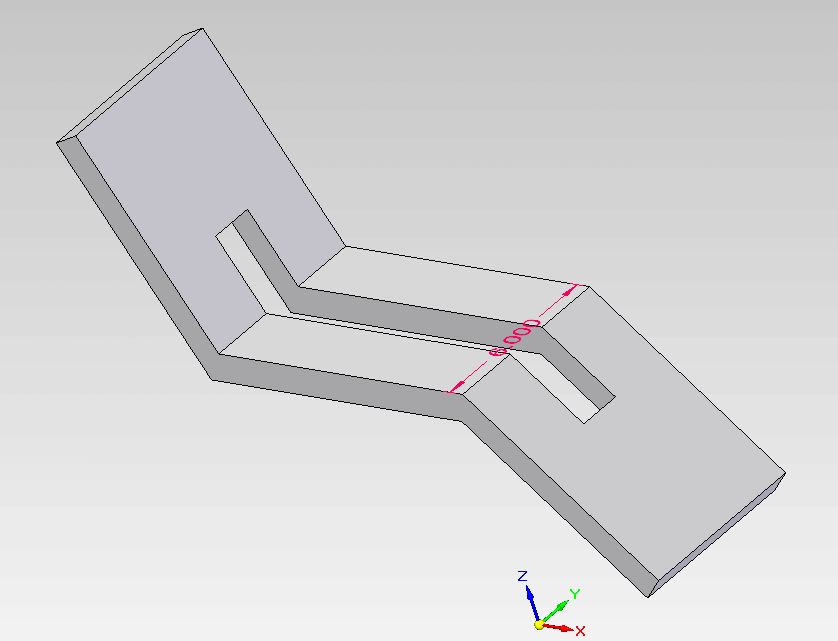
Angle plate with slot   John Devitry is the CAD administrator for Utah State University. His weapon of choice is of course SE and more specifically ST in SE. He was telling us some funny stories about how students who don’t have rigid concepts of how things are to be modeled do things at times.  He would fix them up with a problem and then plan on going away for a while as the problem is solved only to see some students walk out after 5 minutes or so. Thinking there is a problem as he says he would walk over to see if they needed help only to be told they were done.

  Here is one of the problems he gave his students.  An angled plate with a slot in it and a 90 degree angle relative to all three major faces.   The first thing I thought of, and admit it you did to, was sketch/extrude remove in three planes. It took me a bit to figure out what the student did but the following is a clip of how I believe it was done. 

  This was one of the things that just blew me away at the Huntsville ST4 Rollout/Summit. ( I can’t help myself here and even though SE called it a rollout I like to think of it as the first of the new series of Summits :-])  It’s not that I had uses for this in mind or could see immediate applications for it in what I do as much as it was a wake up call to capabilities and methods in ST I had not ever considered because of the mindset I have about the way things “should”  be done.

                                                             Regards, Dave Ault