One of the current posts at the Siemens BBS for Solid Edge has a topic of interest to me and it is in part about the useage of Synchronous Technology over traditional by current users and the logic employed by ST. Dan Staples had a reply there and it was as follows.
“Re: OK, so why aren’t you using ST?
We had some good sessions at the Productivity Summits on Live Rules and it gave me an opportunity to summarize that they are nothing more than applying basic human reasoning to CAD. Take any part you see lying around your operation — it doesn’t even have to be in CAD — maybe it’s better if its not. Just look at it and see if you can name some of the design intent that clearly exists in the part (and of course a physical part has no sketches and history tree). What do you see? Stuff lined up? Stuff tangent?
I’d bet some things you are going to see (depending on the part) are; 1. The part is symmetrical. 2. There are tangencies between faces. 3. There are holes that all line up, either sharing the the same axis, or all in a row along X or Y 4. There are faces that are clearly in the same plane. Do you suppose these things happened by accident? No, someone (maybe you) designed it that way. You don’t need a sketch and a history tree to tell you that — you as a human can look at it and see that design intent in the final part very clearly. Why can’t the CAD system see this? Answer: It can. That is what Live Rules is –> Applying basic human-level analysis to a part to mine the intent that is inherent in it. Then, its up to you if you want to override that reasoning on a case by case basis, or let it do what is naturally apparent in that part to humans (and now to CAD via Live Rules).
Dan Staples Director, Solid Edge Product Development”
I had an incident in my shop this past week reflects upon what he said. A friend of mine had a part cut wrong and he brought it over for me to weld the boo-boo so it could be recut. When you do a weld fill-in on a cut part it is always best to rough recut it before you leave the welder’s shop if you can. You can have low spots very easily as you have a fine line to walk between just enough and gobbing way to much on a part just to make sure.
Now for some reason Bobby just could not remember that my lathe was not the one in his shop he was used to using. So he would start it up and then immediately reverse it because it was going the wrong way. I let him do that a couple of times before I stopped him and pointed out that it was hard on my lathe for him to do that. He sheepishly admitted he knew that but my lathe was wired wrong. So I pointed out to him the logic behind the engage lever. I said think of the direction of rotation you want to go in and pull the lever in that direction and you can’t go wrong. My creature of habit friend never did it again once it was explained to him in those terms.
What you say about ST makes perfect sense to me Dan. ST is a different mind-set and while it does not do it all it does so much very well I can’t imagine working without it for the parts my company makes.
There is a learning curve with ST and a logic mind-set and as is true with any tool it can’t be used for everything. But once you use it I dare say that there will be no return to a world of straight history based parts creation. The power of direct editing is to powerful to ignore.
This is a go no go plate for checking filled capsules for defects like split caps. If there is a split the capsule will not fall through. The holes have two draft angles and a cylinder. Now with ST I can create this plate as I did before meeting with my client without knowing precisely the size of the cylinder. He brought the data with him and I sat down and edited the hole that was the origin of the pattern and had a correct resized part in seconds. Literally. It is always a bit amusing to see a customer sit down for the taking of time for the editing of the part he knows is coming. He is used to traditional history based editing after all. On a part like this it took perhaps a half-minute from beginning to end. In the future there will be other capsule sizes and each one will take more time to open the original part file and create a new file name and save the new derived part than it will to edit and create a whole new part size. When you turn to your customer and say “thats it, were done” it is good manners not to tell them to pick their jaw up off of the table 😀
A change of mindset and learning new logic has been tremendously productive for this shop. I look at parts like this and remember how it used to be and I don’t ever want to go back.
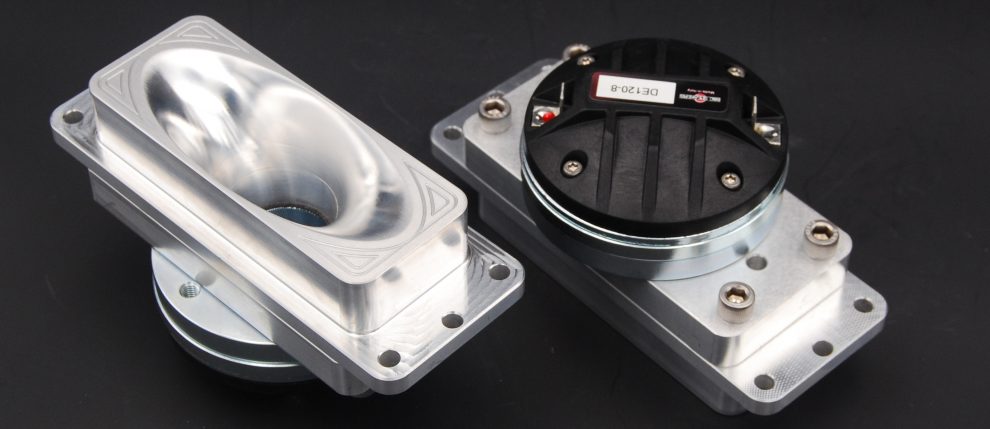


 Machined Audio Horn Lens