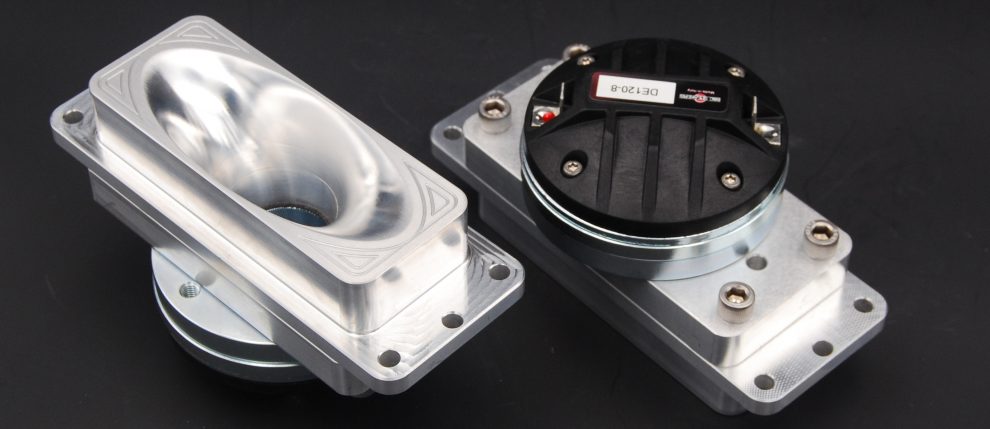
There are times when I get people who want to buy just a set of SMAHL lenses from me, which of course I am delighted to do. However for the sake of avoiding bad choices on the buyers part I am learning to ask questions about intended use. Perhaps the most common one is what driver do you intend to use.
I think some make assumptions about their K-77’s without ever having taken them apart. They just assume I guess that everything fits everything because it will save them money by reusing that old dog barker K-77 magnet and diaphragm assemble.
Now I think it is time to explain something here before I go any further. Why would you want to reuse any part of these old Klipsch tweeters is beyond me. Whether it is the Ti diaphragm bandage on the 2.5cm lens like those on a Forte or Chorus or Cornwall 2 and on, or thinking that you can reuse the old magnet assemblies, even if you could which you can’t though, why? Why take inferior parts of old designs long since passed by with current state of the art designs which sound much better, and cripple new parts with bad pieces.
In the case of the Ti diaphragms you still have that old horn and magnet and phase plug. All you have done is refresh the OEM diaphragm with one that will sound shrill and tinny and are not cheap. It might sound better then the old one did but replacing worthless with bad is not an option I would choose. I had one set of those Ti diaphragms and that mess was part of what led me to designing the MAHL’s to begin with. I thought they were awful and listed them on EBay right away.
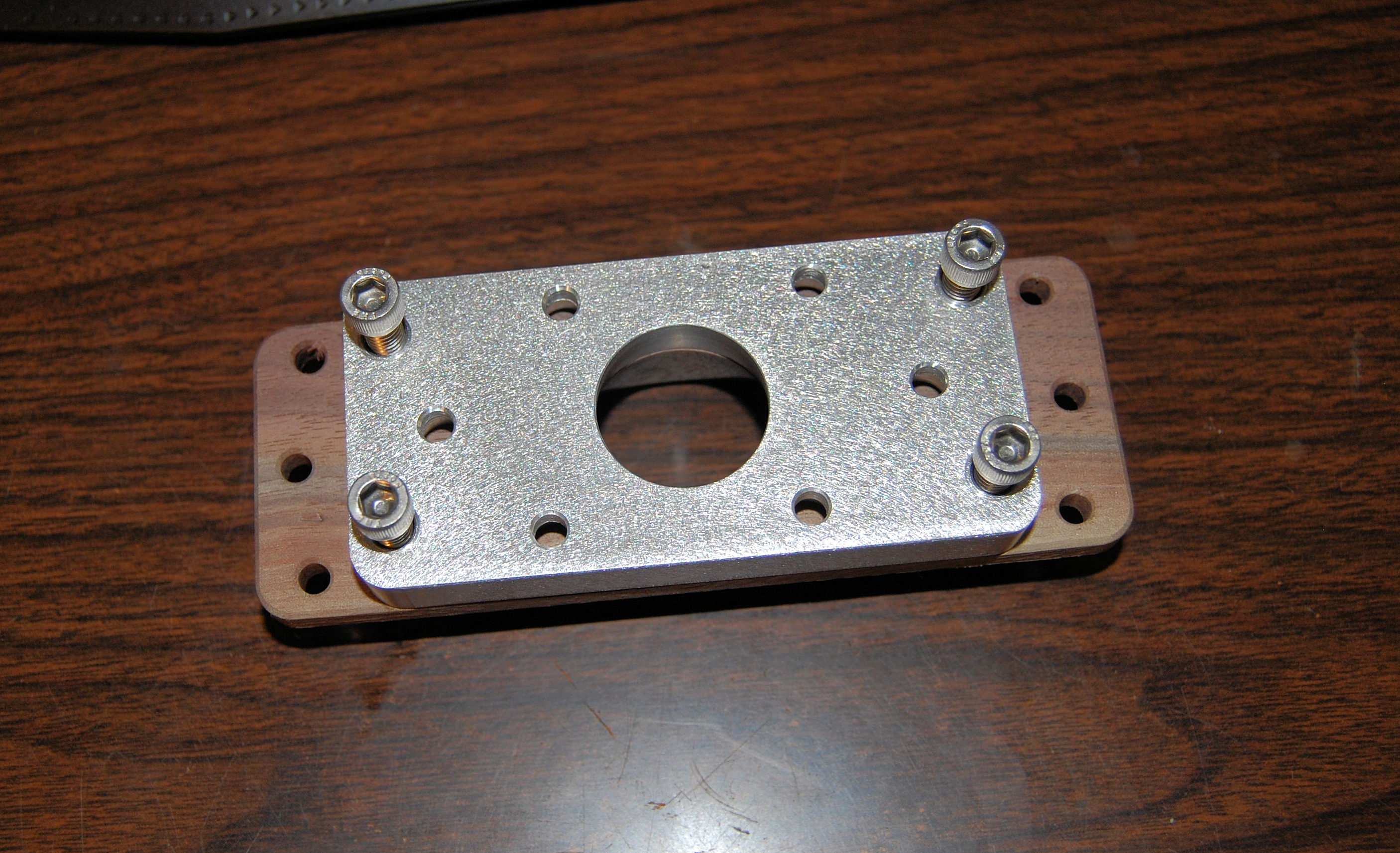
In any case though I digress and back to the dog barker. It is time to talk about that money saving idea of reusing the K-77 parts. Here is the clamp plate in position with the face that the drivers mount onto. This clamp plate has three hole patterns for commonly available current drivers.
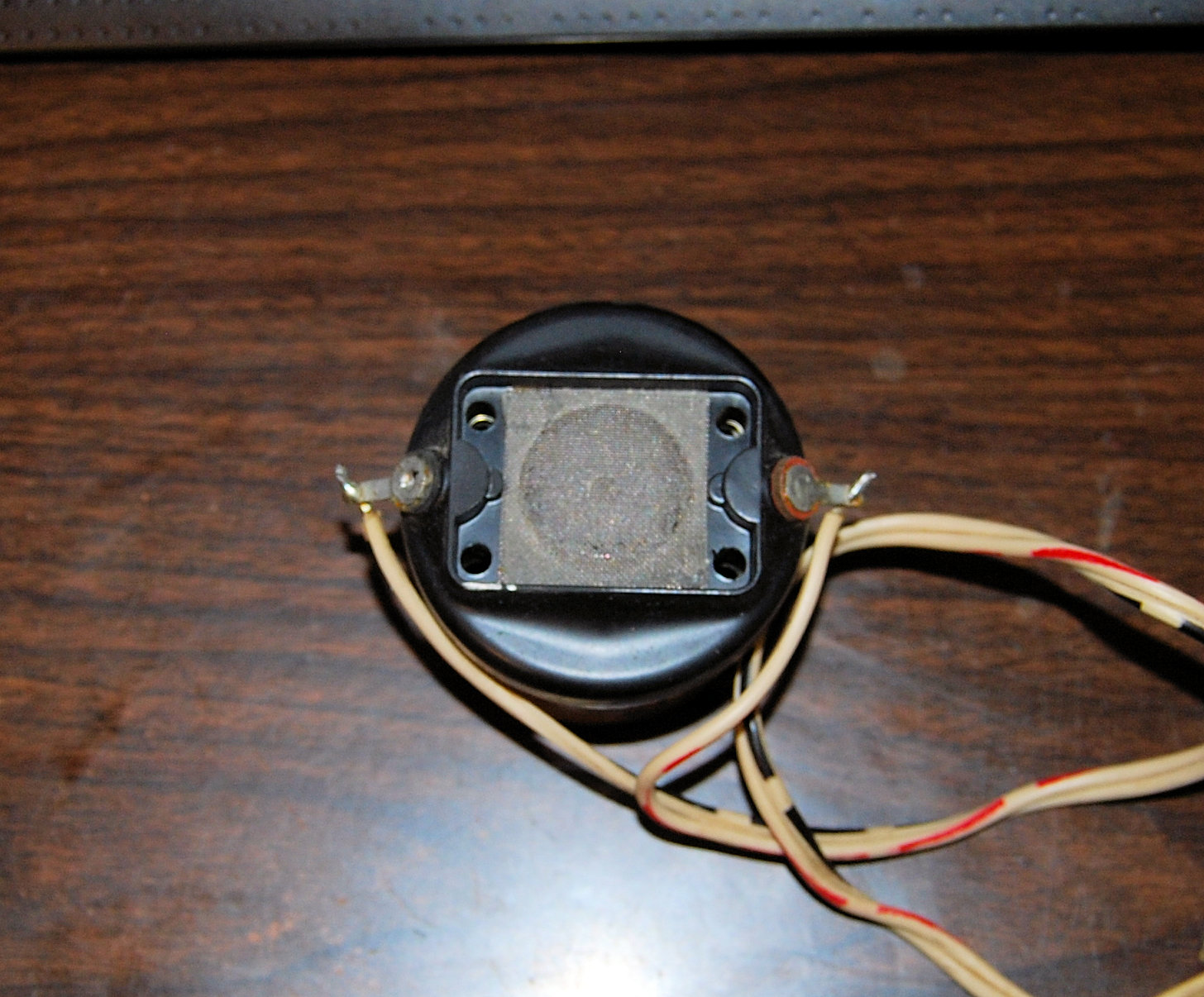
Here is the base of the magnet assembly and the diaphragm is in behind the bug screen. Lots of these old K-77 drivers go bad because they are 5 watt drivers and subject to power problems far more readily then the DE-120 drivers which are 20 watts. Notice the raised boss on the bottom which will only fit
This old diecast zinc horn lens with it’s design which was not changed or updated in any significant way for over 40 years. I have a couple of the old late 60’s chrome plated EV-35’s in my cabinet with the same exact horn as the K-77’s used all the way through the early 2000’s. Time and technology passed these poor things by and Klipsch could have cared less because of tradition. Customers have been buying these for a long time so why change was the corporate philosophy I guess.
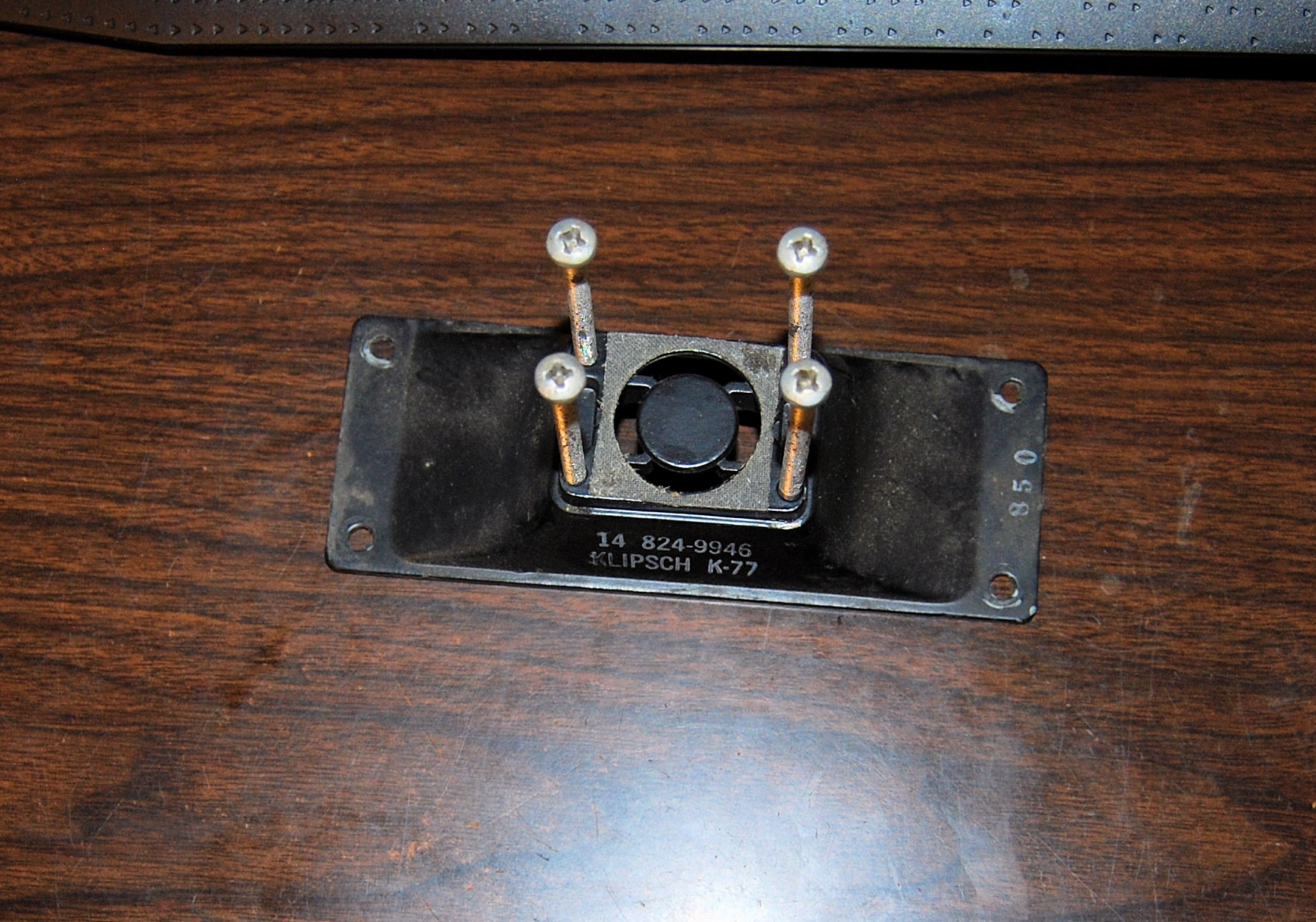
There is no way to make this stuff work with SMAHL’s. I do not intend to ever make an adapter to allow for doing so either because this bad sound set of parts was what led me to looking elsewhere to begin with.
Another thing that comes up once in a while is substitute drivers for the DE-120. The number of drivers that will actually fit the restricted spot the K-77 went into are very few. I was asked this week again about using DE-10 drivers on the SMAHL. Yes while there is a hole set there for those bolt patterns the DE-10 is much to large in diameter to ever fit your old La Scala or Heresy or K-Horn on Klipsch OEM cabinets.
I am amazed at the durability of the older Klipsch plywood Heritage speakers and with the replacement of crossover caps that need changing and ditching those crummy old tweeters those Klipsch speakers can readily be made much better sounding and will last you a lifetime.
 Machined Audio Horn Lens
how to buy those Machined Audio Horn Lens for La scala? Please info.
my email is :email removed by me
You have a PM headed your way Kenny
Dave,
I just found your site. I’m upgrading a pair of KLF-30s & was hoping to find better tweeter options than just adding a titanium diaphragm to the old K-79. Can you help?
Thanks,
Matt
You have a PM headed your way and thanks for the interest.
Hi Dave – I am interested in these as well as having you custom build / machine some for a project I’m working on.
Please email me your contact information.
Thank you.
PM on the way and for those who are interested in this type of work I do cut custom lens sets on occasion.
Hi Dave, I’m interested in a pair of SMAHL’s for a Khorn rebuild. My email is:
Thanks!
Hi Jerrod. PM sent and your email removed from your message to spare you from email harvesters.
Hey Dave, I’m interested in LMAHLs for Chorus IIs. Can you send me a PM?
You should have had a PM. Let me know if you did not.
Hello Dave, I’d like to purchase a set of your LMAHLs for my Chorus IIs. Can you PM me?
Hi Dave, looking to upgrade the ole tweets on my 1990 LaScalas, wanna send me an email? Thanks a bunch
PM on the way.
Hello,
I have a pair of Mundorf resistors linked to my tweeter, the DE 10-8, after the crossovers. Are they absolutely necessary? The tweeters are bolted to your lenses. Thanks.
I need to ask a few questions. How good is your hearing? What speaker are these going into? What value are the resistors and who put them in the circuit? Do you have a schematic of what was done that you can post?
In general when properly selected a set of fixed resistor L-Pads will attenuate the tweeter to match other components that are not as efficient as those 107db efficient DE-10 drivers. Sometimes with poor hearing you can use the boost from a better tweeter output and it serves well to bring back those sounds you were missing. If the tweeter is too strident with better hearing you need to attenuate them with an L-Pad.
Matching your resistors correctly to the attenuation desired can be somewhat tedious at times. The best results I have achieved to date were with online calculator values. However if the value stated say 4.1 or 5.3 that is exactly what I did even if it took two resistors in series to accomplish this. 1/2db attenuation plus or minus in a speaker design I have makes a difference from nice sounding to remarkable sounding. Too often I think companies look for closest round number components for crossovers and L-Pads and settle for good enough. You dial in to precise calculated values for inductance, unwinding the coil if need be to get to the right value(which takes a good inductance meter), couple capacitors to get exact values and same for resistors. I have used up to three capacitors to get precise values for instance because you have to use what you can find.
With Klipsch crossovers I have not changed values of anything but rather just refresh caps. I am not smart enough about all this to understand the tricky things they do with seemingly simple crossovers and I leave fiddling with them to others. I do recommend attenuation on things like Forte 1’s and KLF20’s for most people though.
I happen to like and prefer the EV T-35, K-77 tweeter as originally designed; call me a purist. If you think yours is better, promote it and sell it as an alternative but I personally will continue to use the original design, which I even prefer over Klipsch’s replacements. If I need to replace the diaphragms I will, but the impedance checks out in-range and crossovers have been checked and re-capped using audio-grade capacitors.
You mention you like the old tech so I am curious as to what others you have actually tried in your speakers that did not work? What speakers do you have?
Audio is certainly subject to personal preference and one size does not fit all. I have also had a couple of others out of the hundreds of sets of SMAHL’S sold now that went back to the old dog barkers. To you they are just fine and that is the important thing as you are the one listening.
Of course I do think mine are better as do many happy customers. I do promote them and I do sell them as alternatives so I presume you have not dug very deep into what I offer. You can read what others who have actually bought them have to say on EBay reviews for “SMAHL V2” tweeters or AudioKarma comments. They are discussed on every Klipsch forum some more then others of course. Used to be talked about a lot on the official Klipsch forum until anything not purely Klipsch got run off about two years ago.
hi Dave, this is Jim W from Indiana. Just so that everyone knows I can certainly vouch for all of Dave‘s products as I use multiple copies of them in my La Scalas Khorns and Heresys. They certainly sound better than the old outdated products. Dave’s products are outstanding quality, plus he is a nice guy…
Hi Jim and thanks for the kind words. Sorry for the really slow reply. For some reason I did not get notification to my email and until I checked in to do another post I was oblivious to new comments.
Hi there, I am very interested in a solution like this for my Forte I’s, let me know what you might have a vailable?
PM sent.
Hi Dave, Steve Deal here in Indiana. Do you have a website for your speaker business? I need some of your expert advice please. Thank you.
Check your PM. For those of you who wish to contact me a comment here will do that and I will send a PM to you. I enjoy talking audio and never mind talking to others who enjoy audio as well so reach out and I will reply.
Hi Dave!
Just picked up a pair of completely original 1979 Heresy 1s. I’m hoping to build them up to the Super Heresy 3s outlined on some of the forums I’ve seen you (and Claude) post in.
I’d love to get in touch with you for recommendations on what updates would be recommended and to order a set of the SMAHLs to get started.
Hope to hear from you soon. Thanks for all your hard work and happy holidays!
PM On the way!
Hi, i read many pages but i still have a doubt/question :
the DE120 seems to be a little more sensitive to the K77, is it necessary to do anything to the filter of la scalas to accomodate to that? Will i hear more sibillance in the upper response?
Sorry if my english isn’t clear/ precise, i am not native speaker.
Is the mounting tight in la scalas with the DE120?
Thanks a lot for your work !
I assume the DE-120 is more sensitive but I have never seen the actual DB rating of the K-77. I never changed the Klipsch crossover around in the various models I installed tweeters in with no problems. The vast majority recap the crossover and do not change anything around while doing so. There are always a few who change values around and tinker with crossovers but I am not one of them. I do however recap each and every one I get my hands on.
The improvement in detail is pretty startling and it has none of the sharp sibilance of the K-77. More definition especially with percussion and that ranges from the Xylophone to cymbals and “kickier” kick drums. Stringed acoustic instruments wake up and you can hear the finger work and nuances of the players effort but not in that harsh way the K-77’s often do. More horn blat. Really more of everything that makes music worth listening to, assuming you have a good high quality recording to begin with to listen to. Rule #1. You have a crap recording a great speaker is going to do nothing more then play crap more accurately. The single most overlooked part of quality audio.
One of the primary benefits the MAHL’s bring to any speaker they install in is increased coherence in the output quality. The bass and mid range drivers sound fuller and cleaner and along with the MAHL tweeter make for a real sound quality improvement.
No La Scala had space to spare around those K-77’s but where the K-77 will fit so will the SMAHL which will fit the cutout and reuse the same four original screw holes.
Hi Dave,
I have a pair of original LaScalas that I am interested in getting new tweeters for. This is inclusive of the lens and wires. I would like more information on what the best option would be as a drop in replacement suited to my cabinet. I’d be happy to share photos to help identify what I’m working with.
Thank you!
Fortunately the la Scalas are pretty straight forward. There are only two basic cutouts Klipsch used. The small cutout for the K-77-M and then a larger cut out for the K-77-D and K-77-F which began production in 2001.
So, one of two types will fit your LS and sending a picture is always best but the tag data will also work just fine. The only other choice would be do you like wood? These are cut in wood also which I find more esthetic. Aluminum is stronger and they both sound the same.
FYI La Scala History.
LASCALA:
1963: The La Scala is designed as a portable version of the Klipschorn to be used as a P.A. system for Winthrop Rockefeller’s Arkansas gubernatorial campaign. Component designations were: Woofer K-33-J (Jensen), Midrange K-400 horn and K-55-V driver (Atlas), Tweeter K-77 (Electrovoice).
1966: The designation for the Type 1RC crossover network was changed to Type A.
Sept 1967: Transition to the K-33-M. The records are not clear as to the origin of this driver but it is believed to be an Eminence driver with an Alnico magnet.
Jan 1968: Transition to The K-33-P Woofer (CTS Paducah KY)
1971: The Type AA crossover network was introduced featuring Sneer diode tweeter protection.
1974: K-56 mid-range driver (Electrovoice 1828) is used for a short period as a temporary replacement as the supply of K-55-V drivers was interrupted.
1975: Transition to The K-33-B Woofer (CTS Brownsville TX)
1975? – 1979: K-33-E (Eminence) and the K-33-B were used interchangeably.
1979: The Eminence K-33-E woofer is used exclusively.
1983: The Type AL crossover network was introduced incorporating steeper filter slopes for enhanced tweeter protection and smoother response in the crossover regions.
1983: The Type AL-2 network was introduced to accommodate the new K-55-M mid-range driver. This Electrovoice sourced driver was essentially the same as the previous K-55-V with a smoother response.
1987: The aluminum K-400 horn was replaced with the K-401 structural foam horn resulting in slightly improved distortion figures.
1989: The AL-3 network was introduced to correct for a shift in the output of the K-55-M mid-range driver.
2000: Electrovoice ceases production of the K-77-M and K-55-M tweeter and mid-range drivers. The search for replacement drivers and the acquisition of the EV tooling is sought. Very limited production of a few pairs occurs at the end of 2000 and the early months of 2001 using existing part stocks
May 2001: The Atlas PD-5VH (Current version of the previous K-55-V) is modified slightly and christened the K-55-X. The various components of the K-77-M tweeter are either retooled or sourced from the new owners of the tooling and assembled by a third party. This variant of the tweeter is designated the K-77-F. An entirely new network (AL-4) was created to accommodate these driver changes. Fusing is eliminated in favor of a polyswitch for tweeter protection. The tweeter on the La Scala was flush mounted for the first time using “Z” brackets. A metal input panel with binding posts in a bi-wire configuration replaced the traditional screw type barrier block.
Dec 2005: The La Scala II debuted as the first “finished” version of this model featuring a two piece veneered cabinet utilizing 1″ MDF instead of the traditional 3/4″ plywood. The AL-5 network was introduced to compensate for the improvement in low frequency response resulting from the change in cabinet construction. The HF and LF cabinets stacked together using thick rubber isolating spacers. Finish variants were reduced from 6 to 3.
April 2006: The horn portion of the K-77-F tweeter was re-tooled to include a recessed flange eliminating the need for the separate “Z” bracket and attachment rivets, the new designation is the K-77-D. This also allowed the updating of pre-Z bracket La Scala’s (prior to May 2001) to flush tweeter status without motor board modification.
2008+: There have been a number of new versions produced, and Klipsch has transitioned the crossovers to a more modern design. For information on the recent changes, please go to the website (Klipsch.com) for product information.